
On the restoration of hair.
A running publication from Hair Labs. Chapters on how hair fails at the level of the cell — greying, loss, signalling — and the windows in which those failures can still be reversed. Open, cited, updated.
The Journal.
Hair Labs Journal publishes the biology of hair restoration: how follicles fail, how pigment is lost, how stress reaches the stem-cell niche, and where the evidence still leaves room for intervention.
Chapters are cited, filmed, and updated as the field moves.
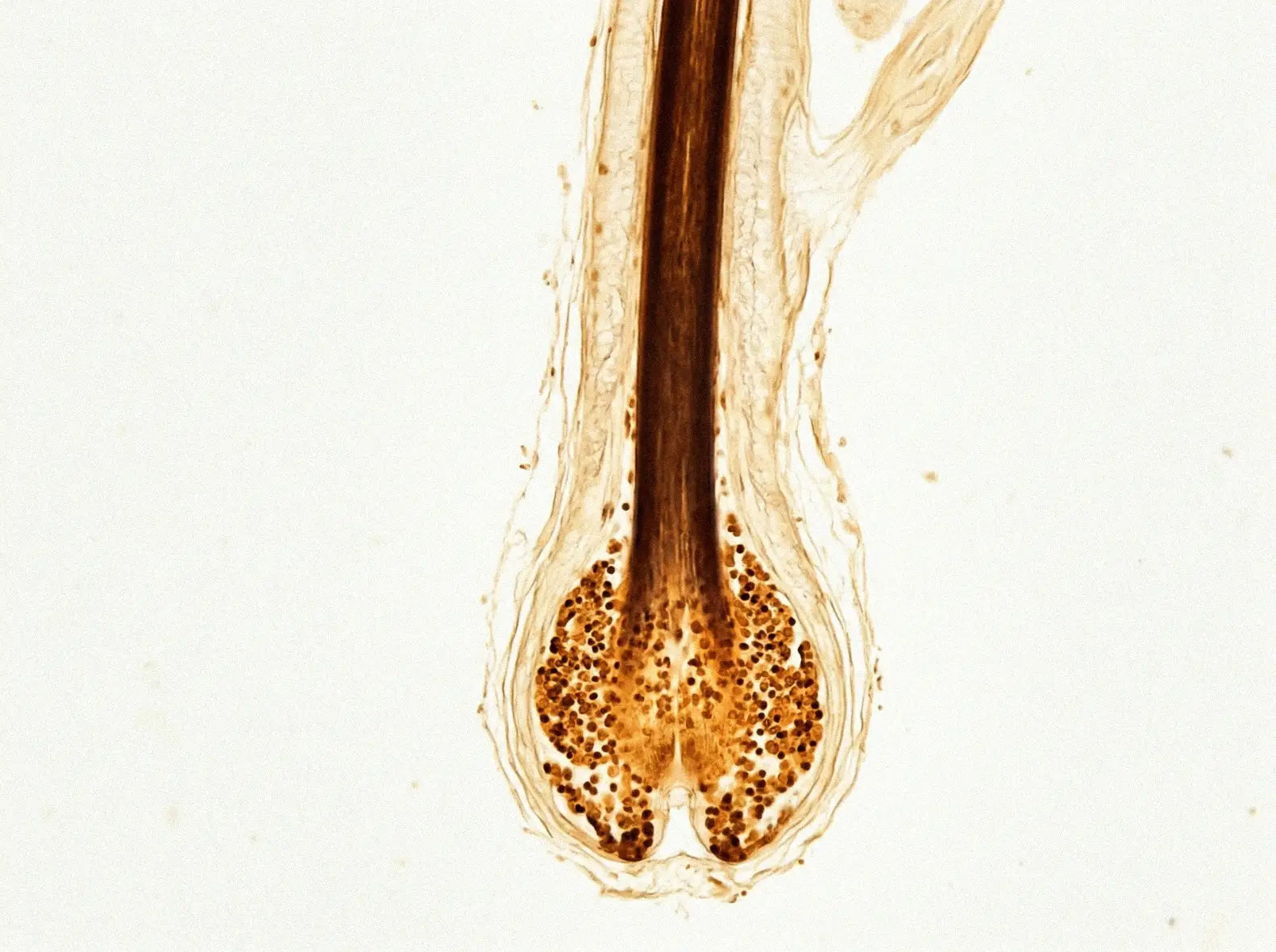
Start here.
Begin with the cascade. Why hair turns grey is the first chapter because every later argument depends on it: greying is not one event, one deficiency, or one age marker. It is a sequence of biological failures at the follicle.
Current question.
The current question is signalling. Hair colour depends on a short-range conversation between niche support cells and melanocyte stem cells; when that conversation weakens, the reservoir may still exist, but it no longer deploys on time.
Published chapters in the Hair Labs Journal. Chapter numbers are archival; new chapters enter the record only when their citation and page record are complete.
- № 01 Why hair turns grey.The canonical monograph. Hair greying as a cascade across six biological drivers — not a single event.
- № 02 Is hair greying permanent?The half of the cascade that can still be undone.
- № 03 How stress greys hair.The nerve-driven arc that empties the pigment reserve in a single shot.
- № 04 Saving the cells behind hair colour.On Luteolin and the window to intervene before the reservoir runs out.
- № 05 When cells stop talking.Signalling failure at the follicle — Wnt, Endothelin-1, and the quiet collapse of coordination.
In progress.
The next chapter is in editorial preparation. It will appear here only when it can stand as part of the cited record: chapter, film, references, and archive route together.
§ 04.
Faculty.
Clinical and scientific contributors to the Hair Labs Journal.
-
01
Dr Mandy Prabhakar
Melanocyte stem-cell reserve
-
02
Dr Pari Oza
Systems biology, oxidative stress, and follicular signalling
-
03
Hayley Handy
Clinical trichology and multifactorial follicle health